Williamstown Community Preservation Committee Hears from Final ApplicantsBy Stephen Dravis, iBerkshires Staff
12:38PM / Tuesday, February 03, 2026 | |
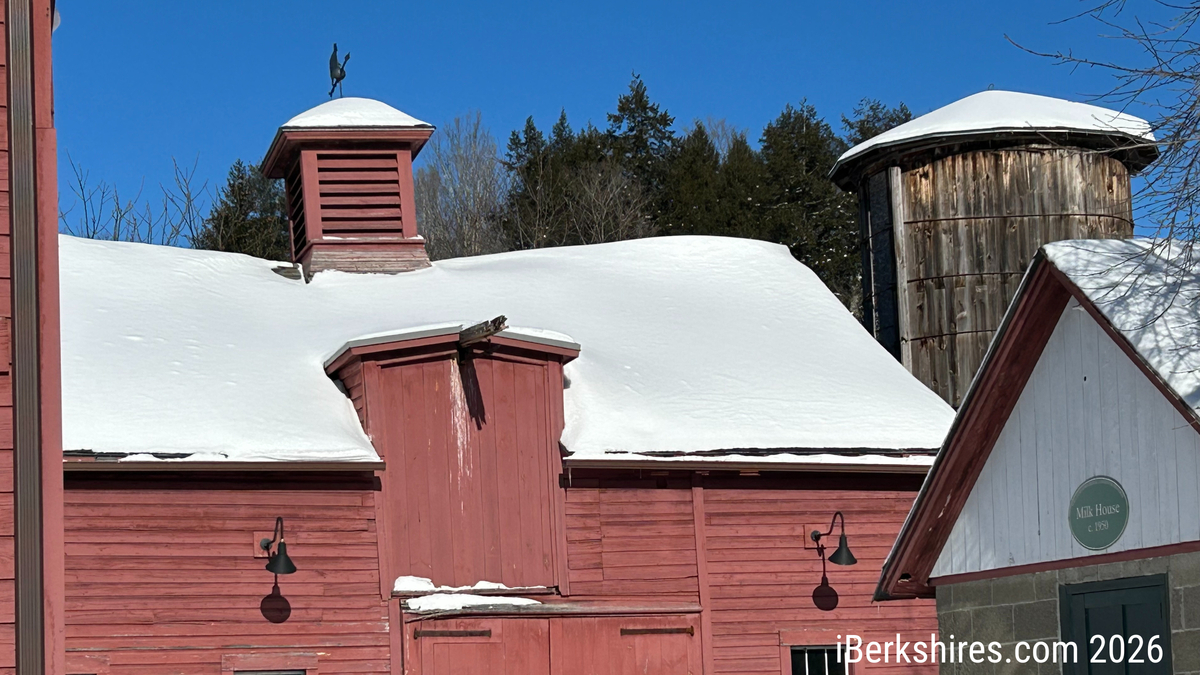 The Williamstown Rural Lands Foundation is seeking Community Preservation Act funds to preserve an historic barn and silo, right, at Sheep Hill. The Williamstown Rural Lands Foundation is seeking Community Preservation Act funds to preserve an historic barn and silo, right, at Sheep Hill. |
WILLIAMSTOWN, Mass. — The Community Preservation Committee last Wednesday heard from the final four applicants for fiscal year 2027 grants and clarified how much funding will be available in the fiscal year that begins on July 1.
On Wednesday, Feb. 4, the committee will begin — and, potentially, conclude — deliberation on how much Community Preservation Act money it wants to recommend May's town meeting spend and how those funds will be allocated across 10 applications the committee received for this funding cycle.
One thing is clear, the committee will not be able to recommend full funding of all the applicants seeking CPA funds in this cycle.
The committee has reviewed just north of $1 million in requests, and the town has, at most, $624,000 to allocate to projects that qualify for CPA funding in one of three categories: community housing, historic preservation and open space and recreation.
The committee heard presentations from the first six applicants on Jan. 21.
One week later, the panel heard from Purple Valley Trails, the Williamstown Historical Museum and the Williamstown Rural Lands Foundation, which has two separate applications for FY27.
Bill MacEwen presented the case for Purple Valley Trails, which is seeking $366,911 to complete financing for a new skate park on a town-owned parcel off Stetson Road, on the site where an out-of-date, dilapidated park was torn down last year.
The skate park group presented the committee with a letter from Williamstown Youth Center Director Mike Williams pledging the non-profit's full support of the Purple Valley Trails application and explaining how the center already has started an active skate club with 30 youngsters participating.
MacEwen took the committee through the history of the project and how previous polling of town residents demonstrated a demand for recreational amenities for pre-teens and teens in the town of 7,000.
And lest committee members think that those surveys were subject to sample bias, MacEwen noted that at last year's annual town meeting, 92 percent of members supported a CPA allotment to fund an earlier phase of the skate park.
Now, the park is shovel ready, MacEwen said that construction on the durable, state-of-the-art, Shock-Crete park can begin this summer.
MacEwen explained that the $750,000 Williamstown project (including pre-development) has about $289,000 in private contributions, including $100,000 that is pledged but contingent on the potential allocation of CPA funds. The projected budget includes, if Purple Valley Trails is successful in this year's application, $428,421 in CPA funds and $31,780 in in-kind contribution from the town (work by the DPW, for example).
He contrasted those numbers with a recently completed skate park in nearby Bennington, Vt., where the town contribution was $825,000 and $100,000 was raised in private contributions toward a $925,000 project (part of Bennington's financial stake came from American Rescue Plan Act funds).
"This is the third year I'm here, and we've been working hard to get this project to this point," MacEwen said. "This committee funded the design phase, which was really helpful. We've gone through permitting and pricing and gotten the contractor ready to break ground, essentially immediately after town meeting.
"We are at that phase that we're ready for capital. When capital goes into this project, it immediately becomes an asset for the town."
In answer to a question from the committee, MacEwen explained that while Purple Valley Trails is a non-profit that is financing the park, it will turn the facility over to the town when completed.
"The skate park is not just for skateboards," MacEwen said. "It's for anything on wheels: bikes, rollerblades, roller skates, wheelchairs. It's a very accessible amenity."
Wheeled recreation also came up in the context of another recreation-related application on Wednesday's docket.
Dan Gura of Williamstown Rural Lands presented the land trust's request for $7,700 for preconstruction work on an accessible trail and pedestrian bridge linking town- and WRLF-owned property around Margaret Lindley Park.
"Rural Lands did some research a couple of years ago to the community to figure out, ‘Who isn't getting to the outdoors and why is that?' " Gura said. "It became clear that accessibility with a capital A was not part of our recreation scene in town in terms of nature. There are physical barriers to getting outside and into the woods, no bathrooms and no parking areas suitable for people with mobility issues."
Margaret Lindley Park has bathrooms and a parking area that could be upgraded to make it more accessible for people with mobility issues.
Likewise, an accessible path with a crushed stone surface and an ADA-compliant bridge in the trail network would open up new recreational possibilities for many residents, Gura said.
"The primary constituent for this project is people living with a disability, although, clearly, many others will benefit from this project as well," he said. "I think a lot of early nature experiences happen [at Margaret Lindley Park]. If you can have a trail suitable for strollers or families or people of all abilities, you're bringing these experiences to people in a very natural way."
Two of the applications the CPC heard on Wednesday fall under the category of historic preservation.
Gura's boss at WRLF, Executive Director Robin Sears, presented the non-profit's request for $25,000 to renovate and repair historic barns at the foundation's headquarters at Sheep Hill.
"The crown jewel of our historic barns is the Dietze Interpretive Center at Sheep Hill, which we call the dairy barn," Sears said. "In the Dieteze Interpretive Center, lots of things happen, including programs, meetings, memorial celebrations, displays of historical tools and implements for farming.
"People are in and out of these barns three seasons a year."
Unfortunately, the barn's roof is bowing under the weight of a cupola that is part of the original structure. Part of the $25,000 application would go toward removing that cupola.
"We'd rather that roof line doesn't break and crush the people inside," Sears said.
Near the barn is an historic silo that has experienced decay and is in danger of toppling. Part of the funds sought would go toward preserving that structure.
Sears told the committee that Sheep Hill draws more than 3,000 visitors a year from the town and throughout the region. It also hosts numerous school groups for educational programs.
Sears also noted in her remarks that she hopes the committee will support an applicant that preceded her at the podium on Wednesday: the Williamstown Historical Museum.
Director Michael Nixon presented the museum's request for $4,000 to restore an historic doctor's buggy from the 19th century.
"Sadly, the Williamstown community and many communities have very little of what sustained our community in that time," Nixon said. "Here, grand hotels were demolished, burned to the ground. So much has been lost.
"But today we have this opportunity to restore a historic doctor's buggy that was vital to the community it served."
And such a restoration would help bring history to life, Nixon told the committee.
"It is not something like other objects that would just be viewed in a glass cabinet," he said. "The preservation would enable us to feature the buggy in town parades, and people would not just think about our shared history but experience the past by taking a ride in the restored buggy. That is where history can come alive and engage the community young and old."
The Williamstown Historical Museum, the Rural Lands barn and silo restoration and an application from Images Cinema ($20,323) fall under the CPA's "historic preservation" category.
The town has just one application under the "community housing" header, from the town's Affordable Housing Trust, which is seeking $170,000.
The rest of the requests — a farmland protection fund for the town's Agricultural Commission ($25,000), the town's renovation of Broad Brook Park ($250,000), Sand Springs Recreation Center ($59,500), the Mount Greylock Regional School District ($100,000), WRLF's Margaret Lindley Park project and the Purple Valley Trails' skate park project — fall under the category of "open space and recreation."
On Wednesday, CPC Chair Philip McKnight explained that out of the $624,000 available to the town in CPA funds in FY27, he recommends the committee follow past practice and hold back a portion, about $14,000, in reserve in case a state match falls short of expectations.
That would leave $610,000.
He also pointed out that the Community Preservation Act requires that municipalities carve out at least 10 percent for each of the statutory categories. In other words, about $62,400 would need to go toward community housing, $62,400 to historic preservation and $62,400 to open space and recreation.
If a town or city does not have enough applications to spend the 10 percent in any given year, the balance of the 10 percent "set aside" is held for future years.
That's good news for the three non-profits seeking funds for historic preservation. The applications from Images, the Williamstown Historical Museum and Rural Lands (for historic preservation) total just more than $49,000, less than the $62,400 set aside.
The Affordable Housing Trust's $170,000 application far exceeds the 10 percent set aside, but that does not preclude the committee from recommending town meeting award more than $62,400; it just means the remaining $107,600 (or some lower number) would have to come from the 70 percent of available funds not "spoken for" by one of the three categories.
That leaves "open space and recreation," where requests total more than $800,000 with about $480,000 left once the 10 percent for housing and 10 percent for historic preservation are deducted from the $610,000 starting point.
And that is where the committee will find itself in territory reminiscent of last year, when applications also exceeded available funding.
This year will be the first that the CPC will be using a grading system it developed over the spring and summer of 2025. The committee's nine members each are submitting rankings for the 10 applications that will be collated to produce scores that the panel hopes will provide a good starting point for its deliberations on Wednesday
Each member's "grades" were due on Friday, Jan. 30, and Kenneth Kuttner, a former member of the CPC who helped develop the ranking system, will aggregate the scores and provide data for the committee by Feb. 2.
"I want to emphasize that the scorecard is not determinative of how we will vote [on applications]," McKnight said on Wednesday. "It will simply inform our discussions next week when we return on Feb. 4 to begin the discussion."
|